


Image: Fundasaun Mahein Nov. 2025
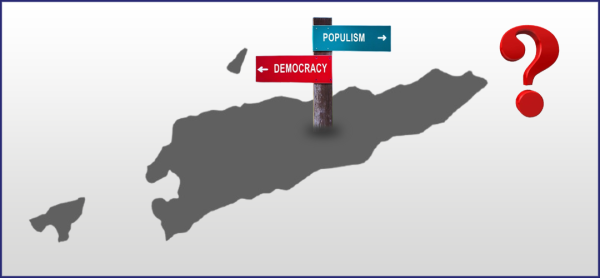
With this article, Fundasaun Mahein (FM) aims to encourage critical reflection on political practices in Timor-Leste, particularly the continued use of populist campaign narratives and elite rhetoric that claims to serve the nation’s future. We examine whether the country is moving toward program-based and generationally inclusive leadership. FM hopes to contribute to this important public discussion at a critical moment, when Timor-Leste has entered a new era of regional integration following its accession to ASEAN in October 2025. This intervention seeks to stimulate substantive debate about political transition, challenge entrenched populist practices and support the development of leadership oriented toward realistic political programs for Timor-Leste’s next chapter.
FM has long argued that Timor-Leste’s politics remains dominated by former resistance figures and military elites who rely heavily on dramatic political rhetoric. However, populist promises have not translated into sustained progress in human development. While elite discourse emphasizes national unity and the legitimacy of the resistance struggle, there remains a persistent gap between these narratives and effective institutional and human capital development.
The continued dominance of resistance-era figures over political decision making and resource distribution has produced a system in which competition revolves around loyalty, patronage and symbolism rather than policy performance or reform. Although democratic procedures exist, the concentration of power among wartime elites limits meaningful participation, accountability and institutional renewal.
While Timor-Leste has adopted ambitious development frameworks, including the National Strategic Development Plan (PEDN) 2011–2030, implementation remains weak. Education, housing, health and employment outcomes lag behind stated objectives. Infrastructure and services are inadequate, youth unemployment remains high and education quality is poor. Significant public funds continue to be directed toward large-scale projects with limited social returns, while the health sector remains heavily dependent on foreign providers despite modest gains.
The Disconnect Between Populism and Programmatic Reform
Populist rhetoric emphasizes unity, resistance and benefits for the people but is rarely matched by sustained investment in human capital or institutional reform. Employment creation has failed to keep pace with the growing youth population, while broad subsidy schemes are distributed without clear targeting, reinforcing dependence on the state. The social contract remains largely transactional, with benefits serving as political rewards rather than part of a long-term development strategy.
Although Timor-Leste conducts free elections and maintains a competitive party system, electoral competition has not produced innovative policy agendas. Weak institutions, limited follow-through on national plans and the continued dominance of the “1975 Generation” constrain reform in key areas of governance and development.
Resistance-era leaders played a central role in securing national unity and ASEAN accession, yet their reliance on informal networks undermines necessary reforms. Prioritising loyalty and resistance credentials over technical competence sits uneasily with ASEAN’s focus on effective governance, economic competitiveness and administrative capacity. This dynamic risks limiting Timor-Leste’s ability to fully benefit from regional integration.
Some observers argue that ASEAN membership may exert external pressure for reform, shifting political success toward measurable results rather than historical legitimacy. Civil society, youth and reform-minded actors increasingly call for leadership models that move beyond “survival politics” and adopt regional best practices centred on professionalism, modernization and youth development.
Group-Based Power and Patronage
Political power in Timor-Leste remains concentrated within networks formed during the independence struggle. Prominent resistance figures continue to exert strong influence over major development projects and state resources, often using infrastructure and public spending to consolidate loyalty. This centralization weakens oversight and sidelines broader participation, prioritising elite interests over societal needs.
In general, access to jobs, promotions and public resources is shaped much more by party loyalty, family ties and patronage relationships than by individual merit. These informal networks allow elites to reward supporters and maintain influence, while public institutions increasingly reflect clientelist practices instead of objective standards.
Patronage-based governance undermines efficiency and public trust. Capable individuals are often excluded due to political considerations, discouraging innovation and accountability. As a result, state capacity remains limited and corruption risks increase as public resources become tools of political bargaining.
Corruption has deep roots in Timor-Leste’s colonial and post-independence history and remains visible in large-scale projects criticised for weak procurement practices and conflicts of interest. Controversies surrounding initiatives such as Tasi Mane, Oecussi development and major road projects illustrate how elite interests shape public investment, often with limited judicial consequences due to weak oversight.
Weak Oversight and the Growth of Impunity
Oversight institutions such as the Anti-Corruption Commission (KAK) exist but face structural constraints, including limited powers and political interference. Investigative journalism has also weakened, with journalists facing pressure and legal threats when reporting on politically connected actors. These conditions sustain cycles of impunity and undermine governance outcomes.
Although anti-corruption laws and institutions are formally in place, insufficient independence, limited resources and political interference restrict their effectiveness. Patronage culture, weak rule of law and the absence of consistent judicial action normalize corruption, eroding public confidence and policy effectiveness.
As a result, progress in governance and human development remains constrained. Merit and professionalism are sidelined in favour of loyalty networks, limiting opportunities for women and young professionals. This environment threatens Timor-Leste’s credibility as a new ASEAN member, where effective administration and transparency are key expectations.
Conclusion
The continued dominance of former resistance and military elites reinforces a political system characterised by populist rhetoric, informal networks and weak merit-based governance. While shared resistance identity sustains unity, prioritising loyalty over competence marginalizes qualified women and youth and weakens institutions. This governance model is ill-equipped to meet ASEAN standards and risks limiting the benefits of regional integration.
Compounding these challenges is the absence of serious planning for generational political transition. Leadership remains concentrated among resistance-era figures, restricting the emergence of new leaders with technical expertise and fresh perspectives. Without meaningful transition planning and institutional reform, Timor-Leste risks stagnation, weakened governance and missed opportunities within ASEAN.

