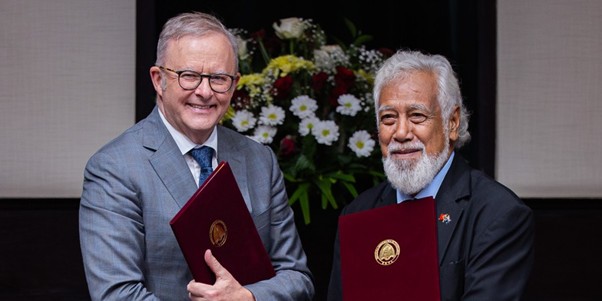
Photo: Australian PM’s Office
Introduction
On 28 January 2026, the governments of the Democratic Republic of Timor-Leste and Australia signed the Parseria Foun ba Era Foun (“New Partnership for a New Era”), a comprehensive bilateral agreement spanning peace and security cooperation, economic collaboration and people-to-people linkages. Coming soon after Timor-Leste’s accession to the Association of Southeast Asian Nations (ASEAN) and amid rising geopolitical tensions, the Parseria represents both a shift in bilateral relations and a strategic response to evolving regional pressures and national development priorities.
The following article examines how the Parseria relates to Timor-Leste’s ASEAN integration and broader Indo-Pacific security and geopolitical dynamics, and assesses the opportunities and risks that it presents for Timor-Leste’s sovereignty, governance and economic security.
FM notes that during the preparation of this article, there has been a major escalation of military conflict involving the United States, Israel and Iran. The full geopolitical and economic consequences of this escalation remain uncertain, though its effects on global energy markets, security and stability are likely to be substantial. While this article has been written against a backdrop of global unpredictability, the analysis focuses on the Parseria’s regional implications and its relevance for Timor-Leste’s sovereignty, governance and external partnerships. FM will continue to monitor the international situation closely and provide updated analysis of its implications for Timor-Leste’s security and regional engagement in due course.
Parseria in Context: From Bilateral Cooperation to Regional Integration
For Timor-Leste, ASEAN membership provides significant geopolitical and institutional benefits, such as expanding Timor-Leste’s diplomatic agency, embedding the country within a rules-based regional architecture and establishing new benchmarks and standards for governance across many areas. The Parseria situates bilateral cooperation between Australia and Timor-Leste explicitly within this ASEAN context. The joint declaration published by the two governments affirms Australia’s support for Timor-Leste’s ASEAN priorities and cooperation consistent with ASEAN’s inclusivity and norms. This signals that Australia envisions its partnership with Timor-Leste as complementary to the multilateral governance mechanisms that ASEAN embodies.
For Timor-Leste, ASEAN offers expanded market access and political-security dialogue mechanisms, while strengthening institutional standards across customs, financial regulation, border management and transnational crime prevention. The Parseria also involves extensive cooperation in these areas, which could help to build Timor-Leste’s capacity both for bilateral cooperation with Australia and full participation in ASEAN. However, for Timor-Leste to receive maximum benefit from these programs, there must be sustained political commitment to institutional reform and capacity strengthening, along with the active involvement of Timorese actors in designing and implementing interventions to ensure local ownership and buy-in over the long term. The widespread failure of donor interventions in fragile contexts to achieve sustained impacts provide important lessons in this regard.
Economic Security: Sunrise, Infrastructure and Human Development
The economic dimensions of the Parseria are critical, especially given Timor-Leste’s increasingly urgent need for structural economic transformation to ensure the state’s fiscal sustainability and provide formal employment opportunities for the growing working-age population. The joint declaration reaffirms commitments to accelerate the development of Greater Sunrise oil and gas resources, a project which has been included in national development planning but has faced significant delays due to protracted political disagreements. The Parseria also entails the establishment of an Infrastructure Fund seeded with 10% of upstream revenue once a commercially viable development concept is agreed upon, which will be funded from Australia’s share.
These aspects of the Parseria reflect an important shift in the economic relationship between the two countries, particularly given the difficult history of negotiations around oil development and maritime boundaries. FM welcomes the constructive approach taken by the two governments to resolving this longstanding dispute which has significantly harmed relations between the two countries. In practical terms, the Greater Sunrise project, despite valid concerns about financial viability and environmental impacts, holds significant economic potential for Timor-Leste, both in providing revenues for the state and advancing industrial development. Moreover, an infrastructure fund – if governed transparently with clear planning and accountability mechanisms – can help align Timor-Leste’s oil and gas revenues more directly with national connectivity priorities and promote economic diversification.
Alongside the Parseria, the Australian Prime Minister has also announced an Economic Cooperation Package through which Australia will allocate $80 million for private sector development and $220 million for a Human Development Initiative. These are complemented by expanded labour mobility and technical and vocational training programs. If designed carefully to ensure local ownership, these initiatives can significantly enhance Timor-Leste’s long-term resilience by strengthening skills, supporting local entrepreneurship and promoting growth in productive economic sectors.
Security Cooperation in a Complex Geopolitical and Criminal Environment
The Parseria’s pillar on peace and regional integration includes cooperation on cyber security, transnational crime, maritime security, border control and migration. These areas are highly relevant to Timor-Leste’s interests while also intersecting with evolving regional security threats. Cybersecurity, in particular, is a serious and growing concern, particularly in light of the alleged “criminal foreign direct investment” in Timor-Leste associated with cyber-enabled fraud centres. These centres of criminal activity have proliferated across Southeast Asia and the Pacific in recent years and led to significant crackdowns by regional governments. In late February, PNTL conducted a raid and arrested eighteen foreign nationals suspected of involvement in illegal online activities, highlighting that transnational cyber-crime remains a persistent challenge in Timor-Leste.
While the Parseria does not explicitly frame cooperation in terms of “criminal foreign direct investment,” the partnership’s emphasis on cyber capacity-building and law enforcement coordination can be read, in part, as a response to these risks. FM has long advocated for enhanced investment in cyber capacity for Timor-Leste’s security agencies, and international cooperation is an essential vehicle for these investments. However, this cooperation must be balanced with careful attention to Timor-Leste’s national sovereignty and questions of local ownership. Interventions should aim to empower Timor-Leste’s own agencies to detect and respond to threats independently, thereby reducing dependency on external assistance. Achieving this requires strong political will on all sides to engage with mutual respect and trust, as well as active engagement by Timorese authorities in the planning and implementation of programs.
Similarly, maritime security cooperation must be tailored to Timor-Leste’s national priorities and targeted towards strengthening sovereign capacity. Improving maritime surveillance and search and rescue capability is crucial for protecting fisheries, offshore energy infrastructure and other sea-based assets. Illegal and unregulated fishing, in particular, poses a serious threat to Timor-Leste’s environmental and economic security, and threatens both the livelihoods of fishing communities and marine resources which are a major draw for international tourists. In addition, there are indications that Timor-Leste’s seas are used for human trafficking and potentially other forms of smuggling, which require significantly enhanced maritime security capabilities.
The Shifting Indo-Pacific Context
As a key arena of global geopolitical contestation, the Indo-Pacific strategic environment is marked by intensifying competition between major powers. This situation presents both challenges and opportunities for small developing states. In this context, Australia’s broader strategic posture – including initiatives such as AUKUS, deeper defence cooperation and increased investment in military capabilities – inevitably shapes its bilateral partnerships are perceived in the region. Timor-Leste, as Australia’s close neighbour with deep people-to-people ties, must therefore ensure that cooperation with Australia does not constrain its longstanding ‘Friends with All’ diplomatic doctrine or its hard-won strategic autonomy.
For FM, the Parseria does not read as an inducement to choose sides in a great-power rivalry. Instead, it mostly provides tools for Timor-Leste to enhance its sovereign capacities within an increasingly multipolar region. Diversification of external partnerships – with ASEAN neighbours, multilateral institutions, development partners and private investors – remains a prudent approach, and indeed is in line with the ‘Friends with All’ strategy pursued by successive Timorese governments.
The Parseria’s explicit affirmation of multilateral structures and norms such as the United Nations Convention on the Law of the Sea, commitment to international law and support for ASEAN centrality are consistent with this approach. However, if bilateral cooperation is perceived domestically or internationally as alignment with one geopolitical camp, it could constrain Timor-Leste’s space for diplomatic manoeuvre. To avoid this, the Government must articulate clearly how Parseria supports national priorities without compromising autonomy.
Opportunities and Risks for Timor-Leste
Such partnerships carry both opportunities and risks, particularly in the current context of rising geopolitical tensions and evolving security threats. Regarding opportunities, FM sees that the Parseria presents several, including enhanced institutional capacity through technical support, especially in cyber and maritime security; economic security through Greater Sunrise development, the infrastructure fund, private sector support and human development initiative; and support for ASEAN integration which can enable Timor-Leste to benefit further from its membership of the bloc.
On the other hand, several risks can be identified, particularly increased dependency on Australian technical support if capacity building elements are not designed to be locally led; and perceptions of “taking sides” in geopolitical conflict between the Western-aligned states and China. The former is a common issue encountered with development aid in general, with which Timor-Leste has had extensive experience. The latter is particularly relevant in the increasingly contested regional strategic environment, as it could undermine the efforts made by Timor-Leste’s political leadership to consolidate national sovereignty since independence. Domestic political polarisation over external partnerships could also undermine the coherence of programs implemented under the Parseria; however, FM believes that the relatively broad consensus among Timorese elites regarding Timor-Leste’s diversified strategic approach makes this less likely.
Fundasaun Mahein reiterates that partnerships must reinforce domestic capacity and sovereignty, rather than substitute for it. The National Parliament, civil society and other independent institutions will play a vital role in tracking implementation of the Parseria, monitoring its compliance with national interests and ensuring that cooperation with Australia strengthens Timor-Leste’s position in the region and more broadly.
Conclusion
The Parseria Foun ba Era Foun marks a significant milestone in relations between Timor-Leste and Australia, close neighbours with a complex shared history. The partnership has arrived at a moment of rapidly evolving regional and global dynamics, including integration with ASEAN and complex security challenges. If implemented with transparency and clear strategic intent, FM believes the partnership can support Timor-Leste’s national development priorities and regional engagement. The primary challenge is to ensure that the Parseria reinforces sovereignty, strengthens governance and accelerates equitable development in alignment with the aspirations enshrined in the Constitution and national development plans.
In an increasingly contested Indo-Pacific and changing global security context, Timor-Leste’s strategic policy must, first and foremost, safeguard national sovereignty by building institutional resilience and solidifying relations with its partners. The Parseria with Australia can be a tool in that endeavour, if Timor-Leste actively shapes it to fit its own vision for a new era. As Fundasaun Mahein has written previously, an essential part of this will be further advancing national dialogue about the form of the state, Timorese political identity and the nature of Timor-Leste’s social democracy. By answering these questions, we believe that this country will be better placed to leverage external relationships to achieve maximum benefits for all Timorese people.