


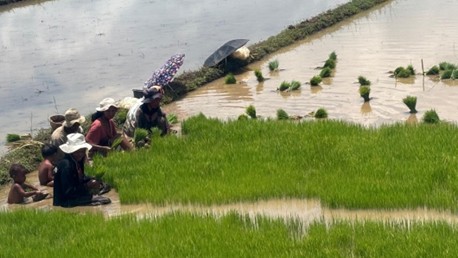
Photo: Fundasaun Mahein – Women working in the fields in Maliana Municipality (07 February 2026)
The following report examines the role of women in community-level conflict resolution and peacebuilding in Timor-Leste, drawing on qualitative interviews with women actively engaged in managing disputes and maintaining social cohesion in Dili and Bobonaro municipalities. It focuses on the informal and often under-recognised practices through which women contribute to peace and stability at the household and community levels.
The findings show that women play a significant and multifaceted role in peacebuilding and resolution of family and community conflicts. They are frequently called upon to mediate disputes, particularly within families, while also working to prevent conflict by addressing its underlying causes. Their contributions are closely linked to everyday responsibilities, including managing household finances, supporting livelihoods and maintaining harmonious social relationships.
A central finding is that women’s influence on community peace and stability is largely informal, relational and often deliberately discreet. Conflict resolution is typically pursued through private dialogue, negotiation and the preservation of relationships, rather than through formal or public mechanisms. Women often prioritise de-escalation and long-term harmony, particularly in sensitive cases where public exposure could lead to shame or further conflict.
The research identifies economic empowerment as a key avenue through which women contribute to peacebuilding and conflict prevention. Access to economic goods such as credit, financial knowledge and small-scale business activities are essential for strengthening family resilience, reducing dependency and enabling women to participate more actively in decision-making.
At the same time, patriarchal norms continue to limit women’s participation in formal decision-making spaces, resulting in a pattern where women exercise influence primarily through informal channels. Moreover, despite the existence of legal frameworks and programs on gender equality, these are often perceived as externally driven or disconnected from local realities, leading in some cases to tokenistic implementation.
The report argues that this pattern reflects the interaction of two broader dynamics rooted in Timor-Leste’s history and socio-cultural context. First, contemporary practices of conflict management are influenced by the legacy of clandestine resistance, which emphasised informal, decentralised and trust-based practices. Second, patriarchal norms shape how these practices are expressed, whereby formal authority is concentrated among men, while women’s contributions remain embedded in family and community structures. The result is a form of “hidden power”, where women play a central role in sustaining social stability without corresponding recognition in formal systems.
The report concludes that peacebuilding and conflict resolution in Timor-Leste cannot be fully understood or realised through an exclusive focus on formal institutions, legal frameworks or programmatic interventions. Fundasaun Mahein maintains that women’s informal roles represent a critical but underutilised resource for conflict prevention and social cohesion.
To access the full report, please click on the link below.
Press Release (PDF)
Full Report MNH 23 (PDF)
Fundasaun Mahein
Email: mahein2009@gmail.com
Telemovel: (+670) 75771766
Website: www.fundasaunmahein.org


