Photo: PNTL, Facebook, July 2026
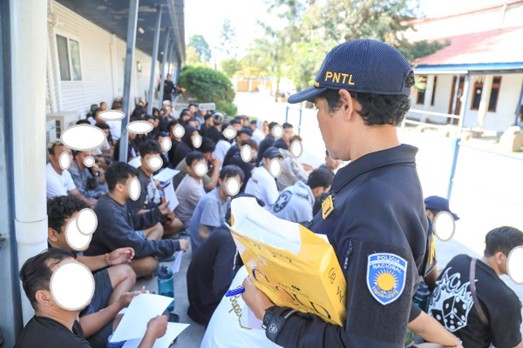
Over recent weeks, Timor-Leste’s security authorities have conducted a major and continuing crackdown on suspected online scam centres operating in Dili and surrounding areas. By 20 July 2026, more than 350 people had reportedly been arrested following raids on multiple properties. Most of those detained were Chinese nationals, with Indonesian citizens forming the second-largest group, alongside smaller numbers of Cambodian and other foreign nationals. Suspects are reportedly being investigated for offences including illegal online gaming, fraud, money laundering, immigration violations and criminal association.
Fundasaun Mahein (FM) commends the Polícia Nacional de Timor-Leste (PNTL), including its investigative divisions, and the Polícia Científica de Investigação Criminal (PCIC), for taking decisive action against these crimes. The scale and continuity of the operations demonstrate that Timor-Leste’s security institutions recognise the seriousness of the threat posed by transnational criminal networks.
The recent operations represent both an important operational success and confirmation that concerns previously raised by FM and other observers require renewed attention. While earlier warnings focused on high-profile offshore gambling investments and other forms of “criminal foreign direct investment”, recent events suggest that criminal networks have evolved towards a more decentralised and less visible operating model. Timor-Leste must therefore combine ongoing law enforcement operations with a broader strategy encompassing intelligence, financial investigation, criminal justice, immigration reform and strengthened governance.
FM has consistently argued that the greatest threat posed by transnational organised crime is not simply the existence of criminal activity, but the gradual fragmentation of state institutions, whereby criminal actors exploit and corrupt governance systems to facilitate illegal activity. Disrupting individual scam centres through policing operations will have limited long-term success unless investigations also identify the organisers, financial networks, local facilitators and – where supported by evidence – any public officials or politically connected individuals who enabled these operations to become established.
From Criminal Foreign Direct Investment to Decentralised Scam Networks
FM has warned for several years that weaknesses in Timor-Leste’s immigration controls, security sector capacity and rule of law expose the country to transnational organised crime. Most recently, FM’s July 2026 report Ghosts in Dili: Aviation Gaps, Scam Networks and a Test of Timor-Leste’s Sovereignty examined how suspected criminal actors exploited weaknesses in aviation governance, immigration procedures, document verification and inter-agency coordination. The report argued that the so-called “ghost jet” incident was not an isolated example of police failure, but rather reflected deeper problems of institutional fragmentation across the state.
Earlier concerns about the penetration of foreign criminal networks centred on large and visible projects such as casinos, digital centres and special economic zones backed by wealthy financiers. At that stage, the principal risk seemed that organised crime would establish itself by presenting itself as legitimate investment and securing licences, land or political support. Following warnings from FM and UNODC, together with subsequent police operations, the Government suspended its proposed iGaming licences and the projects were quietly abandoned.
In FM’s view, the current situation represents a deeply troubling new phase in Timor-Leste’s experience with transnational organised crime. Rather than relying on a small number of large investments to gain a foothold, scam operators appear to have accessed offices, apartments and private compounds across Dili, Liquiçá and surrounding areas, each containing small-to-medium cyber-fraud centres operating independently. One operation in Tibar alone reportedly resulted in the detention of 61 foreign nationals.
Raids Are Necessary, but They Are Not Sufficient
The actions taken by PNTL and PCIC have disrupted ongoing criminal activity, protected potential victims and demonstrated that Timor-Leste will not tolerate transnational scam operations. However, regional experience shows that these criminal networks are highly adaptive. Enforcement actions have repeatedly caused scam operations elsewhere in Southeast Asia to fragment or relocate to new jurisdictions rather than disappear altogether.
The recent raids should therefore be viewed as the beginning of Timor-Leste’s response to a highly complex, long-term challenge. Beyond prosecuting the individuals currently detained, investigators must determine who organised and financed the operations, who controlled or rented the properties, how equipment entered the country, how criminal proceeds were transferred and whether local companies, businesspeople or public officials facilitated these activities. If investigations conclude with the arrest or deportation of low-level workers alone, organisers and facilitators may simply establish new operations elsewhere.
Distinguishing Organisers from Possible Victims
Authorities must also recognise that people working in scam centres may have very different levels of responsibility. Some may be organisers, recruiters, managers, technicians or money launderers. Others may have travelled voluntarily in search of employment but subsequently found themselves subjected to exploitation.
Across Southeast Asia, numerous scam compounds have relied upon deceptive recruitment, intimidation and violence. ABC reported that more than 50 individuals arrested in Timor-Leste were not in possession of their passports. While this does not in itself establish that they were trafficked, it warrants careful investigation to determine who may have been victimised and coerced into criminality.
An Unprecedented Challenge for the Criminal Justice System
The current operations also present what may become the largest organised crime prosecution effort in Timor-Leste’s history. Hundreds of suspects have already been detained, with further arrests as raids continue and investigations expand. Managing these cases will require close coordination between investigators, prosecutors, courts, immigration authorities, prisons and specialist forensic personnel.
Authorities must distinguish organisers from lower-level participants and possible trafficking victims, analyse extensive digital evidence, trace financial transactions across multiple jurisdictions and cooperate with foreign law enforcement agencies. Prosecutors and courts will be required to address complex questions involving cybercrime, criminal association, money laundering, immigration offences, transnational financial flows, human trafficking and potential bribery.
Reports that some detainees have already been released following initial judicial review illustrate the legal challenges these investigations present to Timor-Leste’s justice system. While FM cannot comment on individual judicial decisions, the scale and complexity of these investigations highlight the need for specialised investigative, prosecutorial and judicial capacity, while ensuring full respect for due process and the rights of accused individuals.
FM therefore recommends that the Government develop a coordinated criminal justice response bringing together PNTL, PCIC, the Public Prosecution Service, the courts, immigration authorities and prison services. Given the exceptional scale of the investigations, Timor-Leste should also consider requesting targeted international technical assistance in areas such as digital forensics, financial investigation, cybercrime prosecution and judicial case management.
Immigration Reform: Openness Must Be Combined with Risk Management
The recent investigations reinforce concerns that FM first raised in 2024 regarding Timor-Leste’s immigration system. Media reports indicate that many of those arrested entered the country using tourist visas. While Timor-Leste’s immigration policies should aim to continue to facilitate legitimate tourism, investment and commercial activities, the current lack of adequate screening and post-entry monitoring creates vulnerabilities that organised criminal networks can exploit.
FM does not advocate indiscriminate restrictions against particular nationalities. Criminal risk is determined by intelligence, not nationality, and legitimate foreign visitors make important contributions to Timor-Leste’s development.
Instead, Timor-Leste should adopt intelligence-led, risk-based immigration management. This should include improved passenger-information systems, information-sharing and electronic pre-arrival visa processing where appropriate. Such reforms would strengthen the Government’s ability to identify higher-risk travellers while facilitating legitimate business and tourism.
Investigating the Enabling Environment
Arrests of foreign nationals found inside scam compounds cannot explain the broader question of how these groups secured properties, companies, visas, official authorisations and other logistical support. Allegations concerning diplomatic passports, advisory appointments and other state privileges provided to individuals with alleged criminal links have reinforced concerns about possible institutional facilitation of criminality. FM emphasises that all such allegations must be investigated through due process and that the presumption of innocence must be respected. However, their seriousness, together with the subsequent discovery of multiple suspected scam centres, requires a credible investigation into how these networks were able to establish themselves, despite the highly publicised crackdown in Oecusse in 2025.
Investigators should therefore examine not only those working inside scam compounds, but also those who financed the operations, established companies, secured property or otherwise facilitated their activities inside the country. Any potential involvement of public officials or politically connected individuals must be investigated independently and transparently. Without tackling the domestic factors which enabled these criminal groups to penetrate the country, Timor-Leste faces a cycle of repeated raids, prosecutions and criminal activity.
Strengthening Coordination and National Capacity
The current investigations also demonstrate that transnational organised crime cannot be addressed by any single institution. PNTL, PCIC, Immigration, Customs, the National Intelligence Service, the Central Bank’s Financial Intelligence Unit, SERVE, aviation authorities and the Public Prosecutor all have responsibility for tackling this issue.
In order to avoid institutional fragmentation, FM recommends establishing a permanent multi-agency coordination mechanism for combating organised crime. The body should be capable of supporting joint intelligence analysis, coordinated operations, digital forensics, financial investigation, immigration and company-record analysis, trafficking investigations and cooperation with international partners.
Timor-Leste must also continue investing in specialist national capabilities. Computers, mobile phones and other devices seized during the raids may contain communications and other complex data such as financial records and cryptocurrency transactions. Analysing this evidence requires trained investigators and advanced digital forensic capability. International assistance will continue to be important in this regard, but it must support sustained national capacity development rather than create dependency.
These measures should also complement the aviation and border-management reforms proposed in FM’s most recent report, including stronger verification of official travel documents, improved charter-flight oversight, integrated information-sharing and the eventual introduction of Advance Passenger Information systems.
International Cooperation and Strategic Autonomy
Given the extent of involvement by Chinese nationals and the transnational nature of these networks, cooperation with the People’s Republic of China will likely be necessary, and FM recognises the Chinese Embassy’s offer of assistance. Cooperation with Indonesia is equally important given the number of Indonesian nationals detained and the close movement of people across Timor-Leste’s land and maritime borders. Likewise, cooperation with ASEAN members, Australia, New Zealand and other established partners will remain essential in areas such as cybercrime investigation, financial intelligence and digital forensics. Partly in response to the scam centre issue, the Australian Federal Police has already confirmed that it is increasing its support for cybercrime and digital forensics capacity in Timor-Leste and the wider region.
At the same time, experience elsewhere in Southeast Asia demonstrates that international cooperation against transnational organised crime can, in some circumstances, also advance broader geopolitical and strategic interests. While the nature and extent of such cooperation differ between partners, Timor-Leste should ensure that all foreign assistance – particularly involving surveillance systems, intelligence cooperation, sensitive databases or digital infrastructure – remains transparent, governed by Timorese law and subject to appropriate oversight. External assistance should strengthen national capabilities without creating technological dependency, granting uncontrolled access to sensitive information or providing undue political leverage to any external partner. This approach is consistent with Timor-Leste’s longstanding foreign policy of strategic autonomy and friendship with all countries, underpinned by diversified partnerships and strong national institutions.
Conclusion: A Comprehensive National Response Against the Threat of Transnational Crime
The Government is correct to recognise that transnational organised crime threatens Timor-Leste’s sovereignty, security and international reputation. If the country acquires a reputation as a permissive jurisdiction for organised crime, the consequences could extend well beyond law enforcement, affecting investment, tourism, financial integrity and regional partnerships.
The recent operations by PNTL and PCIC demonstrate that Timor-Leste is capable of responding decisively to emerging threats at the operational level. However, success in the battle against organised crime cannot be measured solely by the number of arrests or deportations. Authorities must also dismantle the financial, organisational and institutional networks that allow these criminal enterprises to operate, while protecting victims of trafficking, strengthening national institutions and preventing new operations from emerging.
FM therefore recommends that the Government:
- Maintain the current investigations and intelligence-led raids;
- Create a permanent multi-agency organised crime coordination mechanism;
- Implement aviation, passenger-information and inter-agency coordination reforms, including stronger document verification, Advance Passenger Information and integrated border-information systems;
- In collaboration with regional partners as appropriate, conduct comprehensive financial and digital investigations into the networks behind each compound;
- Investigate possible local facilitation, including credible allegations involving public officials;
- Distinguish criminal organisers from trafficking or forced labour victims;
- Introduce intelligence-led, risk-based immigration reforms;
- Improve public reporting on the progress and outcomes of major organised crime investigations;
- Engage with international security partners while protecting national data and strategic autonomy;
- Strengthen national capacity in cybercrime investigation, digital forensics, financial investigation and asset tracing;
- Develop a coordinated criminal justice response across police, prosecutors, courts, immigration and correctional services; and
- Request targeted international technical assistance to support complex transnational organised crime investigations and prosecutions.
By taking these steps, Timor-Leste can build on the current crackdown and move beyond dismantling individual scam centres towards a comprehensive national strategy capable of disrupting the wider criminal systems that enable them.