


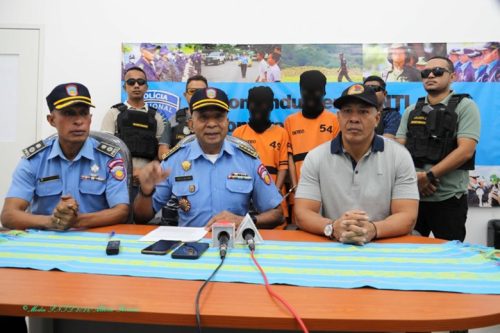
Photo: PNTL (June 10, 2026)
The recent death of a young girl in Dili during the robbery of her phone has shocked the public. Two young boys were soon arrested on suspicion of committing the robbery which led to the girl’s tragic death. The full facts must still be established through a lawful investigation and judicial process. However, the anger felt by the public is understandable. Many people are asking how Timor-Leste reached a point where young people can commit such acts with so little fear of consequence, and where families increasingly feel that their children are unsafe in the streets of the capital.
While violent robbery and theft are relatively rare in Timor-Leste, this tragedy should not be treated as an isolated incident. It reflects a sense of growing disorder and insecurity in daily life among many communities. Across Dili and other urban areas, communities regularly complain about theft of phones, laptops and motorbikes, harassment of women and girls, group fighting, martial arts-related tensions, communal violence and antisocial behaviour by young people who appear to be outside the control of families, elders, schools, police and the state. For many citizens, the problem is not only crime itself, but the feeling that nobody is seriously responsible for preventing it.
In moments of public grief and frustration, some people have called for severe punishment, including the death penalty. When a child dies, and when people feel that criminal behaviour is becoming normal, society naturally demands justice. Harsh punishment may bring emotional satisfaction, but this alone will not solve the deeper problem of youth crime and disorder. FM believes that Timor-Leste must respond firmly, but also intelligently. The country needs justice for victims, accountability for offenders and a deeper national discussion about how youth crime and social disorder have developed.
The public reaction to this case also reveals a deeper problem in Timor-Leste’s justice culture. The faces and names of the suspects have been widely circulated on social media, despite reports that they are under-age. Many people have called for the death penalty or other extreme or extra-legal forms of punishment. This reflects not only public anger, but a broader tendency towards retributive justice: the belief that the purpose of justice is mainly to punish, shame and avenge.
FM recognises that this tendency is not unique to Timor-Leste. In many countries, including western democracies, populations are increasingly frustrated with crime, antisocial behaviour and the apparent inability of the state to prevent disorder. Many citizens believe that courts are too lenient, that offenders have more protection than victims and that state institutions are unable to guarantee public safety. These frustrations are real and should not be dismissed. However, when public anger turns into calls for revenge or pressure for unlawful punishment, society risks creating new forms of injustice and violence.
This case presents a difficult tension. On one hand, there is a strong argument that serious crimes require serious punishment. If punishments are too light, youth offenders may not fear consequences, victims’ families may feel abandoned and the wider public may lose confidence in the justice system. In this sense, punishment has a social function: it deters future crime, shows respect for victims and reassures the public that the state is capable of defending society.
On the other hand, punishment must remain lawful, proportionate and consistent with human rights. If the suspects are under-age, the justice system is likely to apply lighter sentences than many members of the public expect. This may be legally correct, but it creates another danger. If the public believes that the formal system has failed to deliver justice, the victim’s family or wider community may later take matters into their own hands. This could lead to revenge attacks, further crimes and a cycle of violence between families or groups. Therefore, the state must manage not only the legal case, but also the wider social consequences of public anger.
This is why Timor-Leste needs a justice system that is firm, credible and humane. A weak justice system creates impunity. A purely retributive justice culture creates revenge. In FM’s view, neither approach will effectively build a sustained peace or a just society. The state must show that offenders will face real consequences, while also preventing vigilantism and retaliatory violence.
One major cause of the current crisis is the weakness of rule of law in everyday life. FM has written before about the lack of adherence formal rules across many areas of Timorese society, including road behaviour, public administration, construction, security institutions and political life. Too often, formal procedures are replaced by informal negotiation, personal connections, political protection or family-based arrangements. This creates a wider culture in which rules are seen as flexible and consequences are uncertain. If powerful people and public officials routinely ignore formal rules and laws, it should not surprise us when young people do the same.
Illegal and dangerous driving is especially important. Many youth crimes in Dili are facilitated by motorbikes, including phone theft, bag snatching, intimidation, group mobilisation and rapid escape from crime scenes. Young people who commit these offences are often also driving illegally, dangerously or without proper licences, helmets or road discipline. Therefore, tackling illegal driving is not only a road safety issue. It is also a crime prevention issue.
FM has previously argued that poor traffic management and dangerous driving contribute to a wider atmosphere of lawlessness and disorder in Dili. When young people can drive illegally, ignore road rules, modify motorbikes, ride at high speed and gather in groups without consequence, the street becomes a space of impunity. This indirectly enables other forms of street crime and antisocial behaviour. Stronger traffic enforcement would therefore support public safety, crime prevention and the rule of law more broadly.
FM notes that PNTL has recently launched a campaign of checkpoints during the World Cup period, aimed at tackling illegal and dangerous driving practices during football matches. Major football matches often bring large numbers of young people onto the streets late at night engaging in dangerous driving, excessive noise and other antisocial behaviour. Temporary checkpoints can help reduce immediate risks and show that police are taking the issue seriously.
However, a temporary campaign, while welcome, will not resolve the root causes. As noted in our previous writings, Timor-Leste needs a systematic approach to road discipline. This should include regular traffic enforcement, checks on licences and vehicle documents, sanctions for under-age driving, confiscation of illegally modified vehicles, action against reckless driving and stronger cooperation between traffic police, community police, schools and local authorities. Furthermore, provision of adequate shared transport for students and schoolchildren is essential for reducing reliance on private motorcycles, often driven by children themselves.
Another major factor contributing to the growth of youth disorder is the erosion of traditional systems of authority. In the past, families, elders, lia-na’in and community leaders played a stronger role in controlling youth behaviour. Today, these traditional systems are weakening. FM has recently written about the need for Timor-Leste to find a better balance between tradition and modernity. Traditional authority should not be used to silence debate, suppress women or protect abusive behaviour. However, elders, families, lia-na’in and community leaders still have an essential role in guiding youth, preventing conflict and reinforcing social responsibility by reasserting the power of traditional authority to promote respect for individual autonomy, peaceful conflict resolution and the rule of law.
In this sense, state responses to crime are essential, but they cannot work alone. PNTL, courts and government agencies cannot monitor every street, family and youth group. Families, elders and communities must also reassert authority over young people. Parents, older siblings, uncles, aunts, grandparents, lia-na’in and community leaders cannot leave youth discipline entirely to the police. Many young people need stronger boundaries at home: knowing where they are at night, who they are spending time with, whether they are attending school, whether they are driving illegally and how they are using phones and social media.
Widely accessible digital technology and globalised media have accelerated this crisis. Young people are exposed to new images of money, sex, status, violence and consumption, but many have few real opportunities to achieve a dignified life. Recent scandals involving youth, sexual behaviour and digital technology show that Timor-Leste is facing a rapid transformation of social values. Smartphones and social media can support education, communication and opportunity, but they can also spread harmful behaviour, sexual exploitation, humiliation, misinformation and imitation of violent or antisocial lifestyles.
A third and often understudied factor is the unique experience of the post-independence generation. Their parents and older relatives lived through military occupation, fear, displacement and the constant risk of state violence. Many older Timorese grew up under harsh conditions where mistakes could have severe consequences. The post-independence generation, by contrast, has grown up in a relatively free environment. This freedom is a national achievement and should be protected. However, freedom without discipline, opportunity or responsibility can produce a different kind of crisis.
Timorese youth today are not living under military occupation, but they are also not living in a society that provides strong education, employment, civic responsibility or effective law enforcement. Some experience freedom mainly as abandonment: freedom to be in the streets, freedom to leave school, freedom to join groups, freedom to fight, freedom to steal, freedom to harass, freedom to drive illegally and freedom to waste their lives without meaningful adult guidance. This is not true of all youth, and many Timorese young people are hardworking, responsible and ambitious. But for those who are excluded, angry and undisciplined, the combination of freedom, limited opportunity and weak consequences can become destructive.
A fourth factor is the exclusionary nature of Timor-Leste’s development model. Since independence, economic and educational opportunities have been concentrated among privileged groups. Access to formal employment often depends on political connections, family background, education in certain elite schools, language ability and proximity to powerful networks. Young people see government jobs, international agency jobs, public contracts and scholarships going primarily to those with family or party connections, or elite educational backgrounds. If they do not belong to these circles, they may feel that the system has no place for them. This sense of exclusion helps explain why some young people are attracted to martial arts groups, street networks, petty crime or violent forms of identity. These groups provide belonging, protection, status and income, even if they also create danger for the wider community.
The lack of private sector growth makes the problem worse. Timor-Leste’s economy remains heavily dominated by the public sector, petroleum revenues and donor agencies. Formal employment outside the state sector is limited, with the result that access to jobs is often politically mediated. Without a stronger private sector, many young people remain dependent on state-linked opportunities. A young person who sees no pathway to employment, dignity or social mobility is more vulnerable to crime, violence and manipulation.
This does not mean that poverty excuses criminal behaviour. Those responsible for crimes must face justice. Victims and families deserve protection, truth and accountability. But if Timor-Leste responds only after crimes occur, the country will continue moving from one tragedy to another. The deeper question is how to rebuild a social order in which young people are guided, disciplined, included and given real alternatives.
The response must therefore combine firmness with prevention. First, the justice system must act seriously and consistently. Communities need to see that the justice system and rule of law are effective. However, punishment should be lawful, proportionate and aimed at changing behaviour, not simply satisfying public anger. While imposing harsh prison sentences on youth offenders may deter some from committing crimes, it is unlikely to contribute positively to promoting civic responsibility, respect for the rule of law and other positive values.
To address this, FM believes that the Government should consider imposing community work or rural work programmes as punishment for youth offenders, particularly those convicted of non-violent crimes. These could involve cleaning public spaces, repairing community infrastructure, supporting agriculture, assisting elderly people or participating in supervised rural work. Such programmes would create consequences for antisocial behaviour while also teaching discipline, responsibility and respect for labour. They should be combined with education, counselling, literacy support and skills training, so that young offenders are not only punished but redirected.
Third, the state must treat illegal driving as a public safety and crime prevention priority. Regular checkpoints, licence enforcement, action against under-age driving, control of modified vehicles and consistent penalties for reckless driving should become normal, not only temporary responses during major events such as the World Cup. PNTL should work with schools, suku authorities, youth groups and families to identify repeat offenders and prevent motorbikes from becoming tools for crime and intimidation.
Fourth, schools must become stronger centres of discipline, civic education and social formation. Education cannot only mean passing exams. It must also teach respect for others’ bodily autonomy, non-violence, digital responsibility, road safety, rule of law and national citizenship. Young people need to understand that freedom after independence comes with responsibility to build the nation, not destroy the peace that previous generations sacrificed to achieve.
Sixth, the state must take youth inclusion seriously as a national security issue. Youth unemployment, exclusion and lack of opportunity are not only development problems. They are also drivers of crime, violence and instability. The Government must expand vocational education, apprenticeships, small business support, local employment schemes and transparent recruitment pathways. Genuine meritocracy must take the place of nepotism and patronage, so that opportunities are not limited to children of elites, party loyalists or graduates of a few privileged schools.
Seventh, Timor-Leste needs a stronger private sector. As long as employment depends mainly on the state, political connections will continue to shape access to opportunity. Private sector growth, if properly regulated and inclusive, can create jobs outside political patronage networks, which will promote youth inclusion and prosperity and draw young people away from crime and disorder.
Finally, the rule of law must be strengthened across both state and society. The law cannot apply only to poor youth while powerful people continue to violate it with impunity. If the national culture rewards shortcuts, impunity and connections, youth will learn the same lesson.
The death of a young girl in Dili should be a moment of national reflection. It should not be used only to demand revenge, nor should it be forgotten after a few days of public outrage. It should force Timor-Leste to confront a deeper crisis: the weakening of traditional authority, the slow development of modern institutions, illegal and dangerous street behaviour, the exclusion of ordinary youth from economic opportunity and the failure to build a culture of responsibility after independence.
Justice must be done in this case. But justice will not be complete unless the country also asks why so many young people are growing up without discipline, direction or hope. Timor-Leste’s youth are not the enemy – they are the future of the country. But a future generation cannot be built through neglect. It must be guided by principles of family solidarity, respect for elders, economic inclusion, meritocracy, legal discipline, and an inspiring national vision that gives every young person a reason to choose dignity over violence and crime.


